Sunday, August 30, 2020

Summer Reading

 Reading has been tough since the boys moved in, but life has been so rich.


Culture and Value - Wittgenstein

Ludwig Wittgenstein - A Memoir - Norman Malcom

Wittgenstein and Modern Philosophy - Justus Hartnack

- My working memory doesn't work well enough to follow W step by step. Like in chess or other board games, I can only look ahead a couple moves before losing track of the possibilities. But I'm sympathetic to his style, and usually 'get' his insights at some level. I think, anyway.

The Life of Milarepa - trans Lobsang Lhalungpa

- need to read again!

The Rise of Wolf 8 - Rick McIntyre

- The first installment in a trilogy about the wolves of Yellowstone. McIntyre has spent more time observing wolves in the wild than anyone else living. perhaps anyone else ever. The writing is very flat, but the scope is epic.

Amulet books 1-8 - Kazu Kibuishi

- I asked Mom to send book 1 to the kids for Easter. Initially P was way too scared; Ty was scared but enthralled. After a few weeks of dipping his toes into the water, P fell for it and has asked me to read to him from the series almost every night.

The Great Psychotherapy Debate - Bruce Wampold

- Wampold argues that the medical model has misled interpretation of research data on psychotherapy (missing the forest for the trees). His starting and ending point is the equivalent effect of different psychotherapies. In between he demonstrates how research has shown that the "common factors" provide effects much greater than the specific ingredients in various psychotherapies.

Saturday, August 8, 2020

30 by 30

30 books to read by 30

I'm cheating by adding "and/or"!

1. Eiger Dreams or Into Thin Air - John Krakauer

You read, Into the Wild, didn't you John? You might have read these two, but if you haven't, I think you would enjoy them and relate to Krakauer personally, especially in Eiger Dreams.

2. Anything by Terry Pratchett

Granddaddy Richard and Aunt Julie both love this author. I've only read one of his, I can't remember what, something about a young witch learning the ropes. I think his Disc World series is his most famous.

3. Jesus as Precursor - Robert Funk, or Jesus and the Disinherited - Howard Thurman

These two books kinda helped me re-commit to Christianity in college. I expect I wouldn't enjoy Jesus as Precursor as much now, but I re-read Jesus and the Disinherited last year and was moved once again by Thurman's faith.

4. What if? - Randall Munroe.

Richard also lent me this book after he read it. So awesome and so funny!

5. The Half Has Never Been Told - Edward Baptist

An economic analysis of interstate slave trade to and colonization of Tenn/Alabama/Miss/Texas, and how all that ties into U.S. economic super-growth. It's a lot to get through, but very much involves our family. He even begins book by describing how enslaved folks were marched from Danville west and south along routes we now drive frequently.

6. The Education of Little Tree - Forrest Carter

A sweet book, sent to me as a bday gift by Aunt Marrietta, that brought tears to my eyes; I read it one day in HS when I was home sick. Little did I know of its dark and ugly background. Look on youtube for "The Reconstruction of Asa Carter." I think we are related to one of Asa's co-conspirators in their planned attack of Nat King Cole. Also Henry Louis Gates Jr wrote a very good NYtimes piece about the book.

7. Cold Mountain - Charles Frazier

Living in the mountains of NC, if you haven't read it, you will enjoy it!

7. Holes - Louis Sachar

Didn't you have to read this at some point? I've found it - usually, but not always - very fun to pick up books I read as a kid (I didn't read very many).

8. The Hobbit

For example, until I read this as an adult, I didn't realize how well it was written for youth. Very very charming experience.

9. a story collection by Sherman Alexie

I've read a lot of his stuff, so I'm not sure which to recommend. Pick a short story collection.

10. Pride and Prejudice - Jane Austen

I enjoyed all her books, and I'm not sure which I liked the best. But this one is the funniest, I think.

11. Moby Dick or The Encantadas - Herman Melville

I took a class on him and loved it; these two especially.

12. Ficciones or Labyrinths or another story collection - Jorge Luis Borges

I took a class on him too! Also awesome. The Library of Babel and the Lottery of Babylon both stick with me. Kinda dark philosophical-dilemma, mind-bendy stuff. Very much something Christopher Nolan would like.

13. The Electric Kool-Aid Acid Test - Tom Wolfe

Speaking of trippy stories! A wild tour of late-hippie life. 

14. The Miracle of Mindfulness - Thich Nhat Hanh

I wish I could hang out with him for a year or two. Ready anything by him.

15. the Rule of St. Benedict

This is something I return to regularly. Be careful not to sleep with your knife in your belt! Benedict edited as much or more than he wrote. There's so much experience packed into this little book.

16. Sayings of Desert Fathers and Mothers

I'm not sure which collections I've read. I do really like Benedicta Ward's writing style.

17. The Life of St Antony - Athanasius

18. Some biography of St. Francis

I can't remember which ones I've read. I know I read G.K. Chesterton's book on St Francis, which I enjoyed. But Chesterton's personality is so strong, it sometimes masks his subject. He has a fun, apologetic, sometimes exaggerated voice; sometimes it's annoying. Heretics is a fun book of his.

19. War and Peace - Tolstoy

This really is an awesome book. So many cool characters and scenes, and so much dramatic history. Tolstoy's diatribes against the "great man" theory of history get repetitive. Granddaddy David told me a couple times, even before he listened to the book, that he identified with a particular famous scene - where Prince Andrei is injured in battle, is lying on his back staring at the wide sky, and has a spiritual redirection moment (the first of several). https://bigbook2018.wordpress.com/2018/03/16/andreis-infinite-sky/ 

Granddad said he had such a moment once as a boy, lying in the field by the plow while his Dad went to get something, staring at the sky, feeling a benevolent force in the universe. I think he called it a great "friendliness."

20. Zen and the Birds of Appetite - Thomas Merton

I read a lot of his stuff for a couple years; I'm not sure what to recommend. I'm not as big a fan as I used to be, for some reason.

21. Things Fall Apart - Chinua Achebe

One of my favorites, I think. If you read it, I recommend Purple Hibiscus by Chimamanda Adichie as a sequel.

22. Heart of Darkness - Joseph Conrad

I really struggled with it in HS but really appreciated it the second time through. Achebe has a seminal lecture/essay confronting it's racism.

23. Huckleberry Finn by Mark Twain and Kim by Rudyard Kipling

I definitely recommend reading these two back to back. Great stories with lots of similar racist and colonialist innerworkings.

24. Ancient Turkey: A Traveller's History - Seyton Lloyd

One of my favorites from travels in Turkey

25. Any book about Islamic architecture

I don't know why exactly, but I feel very attached to domed mosques. so periodically I'll check out a big picture or history book about Islamic art and/or architecture.

26. The Cloud of Unknowing

Another book that doesn't get old for me. It's the inspiration for the "centering prayer" movement.

27. A book by Martin Laird

He's my favorite contemplative prayer author. His books are Into the Silent Land, A Sunlit Absence, and An Ocean of Light

28. Jesus the Baptist - Richard Vinson

When I was trying to read a handful of books about historical Jesus work/research, Dad sent me this unfinished manuscript. He gives a great introduction to the subject, and then presents some of his findings and arguments. I really really enjoyed it.

29. A River Runs Through It, and Other Stories - Norman Maclean

So beautiful, and it makes you want to move out west.

30. Something by Shakespeare that you were forced to read in school

Go back and read it again. I bet it will be a very different experience. It has been for me.


Monday, March 16, 2020

Only One Floor Brain

   As I continue to learn, little by little, about collaborative problem solving and trauma-informed care - thanks to great UMFS trainers and well-educated counselors in my life - I frequently encounter the metaphor "upstairs brain/ downstairs brain." It's a model used to explain why reasoning, logical consequences, and such discipline/teaching frameworks don't work very well for kids who are constantly dealing with stress and trauma. The downstairs brain contains the "basic" survival and life functions, while the upstairs brain contains the "higher" reasoning and linguistic capabilities. If you consistently face stress or trauma, especially in your early years of life, then you kinda get stuck in a state of stress response: fight, flight, freeze, so forth. The "upstairs" functions aren't very accessible to you when you're running for cover and screaming downstairs. And even when you can make it upstairs, you may not be as familiar with the floor-plan as someone who hasn't had to deal with the same types of toxic, chronic stress.

   From what I've heard, this metaphor has been very successful. Kids and adults both grasp it, and its been especially helpful to counselors trying to persuade parents and care-takers to focus on calming strategies and trust-building before teaching "lessons" and such.

   But...of course I have a but, as always, a but...

   Isn't this another iteration of the mind/body, rational/animal, logic/emotion, male/female hierarchy that we've believed for so long, in the west at least? Besides, aren't reason and language and other advanced skills just a small, relatively recent additional room in the house of the brain? Or maybe more like various pieces of furniture and decoration throughout the house? I don't think "upstairs brain" gets its own floor, with a similar amount of square footage as "downstairs brain." If we have to describe our brain as split between reason and everything else, I like Haidt's metaphor of the elephant with a person riding it, a person who evolved to serve the elephant, not the other way around.

Wednesday, March 4, 2020

Models for Sex/Sexuality/Gender

(2/17/20)
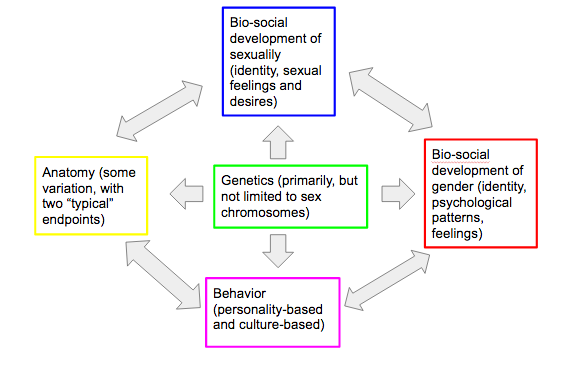
For the past couple days, as my mind wandered during the sermon or during dull moments at my desk, I've been trying to find a good pictorial model or allegory for human sex/sexuality/gender.

I want something that expresses the bi-modal or bi-nodal nature as well as the constellated individuality or brilliant spectrum nature, and that doesn't conceptually privilege or emphasize certain areas or points of the picture. I guess the question is, can you draw a picture with two nodes that doesn't necessarily pronounce those nodes?

At first I thought of a magnetic field
Image result for magnetic field

Like, the field is defined by the poles, but that's not really what the field is. I dunno what I'm talking about.

Or then the rainbow
Image result for rainbow
Which is already associated with diversity, but also has two endpoints. But those endpoints aren't actually places, they are concepts, in the same way that sex/gender is a generalized description of lots of specific facts/experience/ideas/feelings/etc.

I guess I'm really excited by the description of gender and sex that Kandel laid out in his book. I didn't understand how all the interrelations worked, but I visualize it as a flow-chart, of sorts, with five genres of sex-gender identification.


Friday, February 14, 2020

Ezekiel paper

"Then you shall know that I am the Lord." This is Ezekiel's chorus, the book's faithful and terrible refrain. Beginning with chapter six, after Ezekiel's first rush of vision-journey, calling, and performative prophecy, nearly every prophecy or "word of the Lord" ends with "Then you/they shall know that I am the Lord." The phrase occurs over 60 times in Ezekiel (Peterson). For better and for worse, knowledge (da'at) of the Lord (YHWH) is the ultimate result of God's word and action. With and within the moral-justice and religious lessons that God teaches, this one seed is planted and replanted.

-------

Is your holy city being sacked by the mighty Nebuchadnezzar? Are its strongholds toppling? Its people cut down? Its children scattered?

Then you shall know that I am the Lord.

Is the land itself heaving and cracking? The sky darkening in shame and misery? The deep escaping? The fire quickly consuming?

Then you shall know that I am the Lord.

Are your neighbors mocking you? Plundering your riches? Defaming your king? Despising your religion?

Then you shall know that I am the Lord.

Are your enemies falling into the pit they dug? Is your enemy's enemy on the rise? Did a bigger fish just swallow the fish that swallowed you?

Then you shall know that I am the Lord.

Are you experiencing forgiveness? Do you have a fresh spirit and a newborn heart? Have your tears of mourning turned to shouts of deliverance?

Then you shall know that I am the Lord.

Is a new age dawning? A reign of peace on its way? A river flowing out of holiness and into all the world?

Then you shall know that I am the Lord.

-------


Who is Ezekiel?

Ezekiel son of Buzi was a priest from the southern kingdom of Judah. My Bible notes say he was probably a Zadokite priest, because that is a specific priestly group who's faithfulness Ezekiel praises in its later chapters (Peterson). Ezekiel's final vision contrasts the Zadokites’ loyalty to YHWH with the fickle idolatry of the "Levites,” although the Zadokites are technically also descendants of Levi. However, based on Ezekiel's individual suffering (early exile, death of his wife, sorrow) and extreme prophetic demands (laying on side for months with little to eat and drink, long periods of muteness, cutting off hair, etc), you could argue that he was more likely in the "bad" group, the Levites, than the "good" group, the Zadokites. Perhaps there are other reasons Ezekiel is presumed to be Zadokite.

In any case, he was taken to Nippur, or near there, by the Chaldeans/Babylonians in the first round of exile in 597 B.C.E, along with the King Jehoiachin, other politico-religious leaders, and skilled workers. Jehoiachin surrendered Jerusalem, and Nebuchadnezzar then set up a new king, Zedekiah, who's later push for independence brought Babylon's full wrath back onto the city. In 587 the Temple was destroyed and a larger group from Judah was deported.

So, at the beginning of this book, Ezekiel is a priest who has lost his home, his country, and the tangible practices of his religion. By the end of the book, he has lost his wife, perhaps much of his dignity and sanity, and he's lost the knowledge that the Temple, the "delight" of God's eye and His preferred footstool, still exists.

Did he or a scribe listening to him write this book? Who knows, right? The book is certainly well written, architecturally sound, finished and consistent.


Is there a prophetic style?

The only prophetic book I've read straight through more than once is Isaiah, and I guess some of the shorter ones like Joel. But I think I've read and listened to the "classical" Biblical prophets enough to have a slight feel for them, their style and rhythm. I know I'm reading in translation, but it feels like standing in the ocean up to my waist, in the surf and waves. The waves crest and trough, regular but irregular, predictable but always surprising, sometimes breaking upon me, sometimes gently lifting me off my feet.

Reading and studying Ezekiel has not felt like that. There's much more prose than poetry. Certain sections, notably the prophecies against the nations, break into a familiar prophetic canter, but overall the book reads less aurally and more visually. There's an intellectual, heady, mind-over-body (or out-of-body) character to the book, which is a bizarre thing to say, considering how Ezekiel often has to embody his prophecy.

The only definition of a prophet that really sticks in my head is "someone who conveys a 'word' from God." Abraham Heschel and Walter Brueggeman primarily highlight the poetic-sympathetic awareness and style of Biblical prophets, and they lift it up as a key to the meaning of prophecy in general. But Ezekiel pushes that definition, perhaps transgresses it.

For example, in his visions, he clearly brackets their beginning and ending as visions, and he's careful to say that what he sees is "something like" a wheel within a wheel or looks "like" burnished bronze. He doesn't dare say that he's seen or encountered the here-and-now glory of YHWH. Yet, despite his descriptive caution about the Glory of the Lord, he is extremely sharp and precise in his spacial and geographical language. In his initial vision he is very careful to describe where things are in relation to other things ("over," "under," "next to," etc.). The prophecies against other nations are filled to the brim with place names and fascinating geographical references. In his ultimate vision of the new temple, his spirit guide measures every nook and cranny and commands him to remember all the various cubits!

In his prophecies there are no seamless shiftings between his words and God's words like you might find in other Biblical prophets. Whenever Ezekiel speaks it is clearly demarcated. In fact there are only a handful of his personal words in this book, mostly words of dismay or petition. Exclamations like, "Ah Lord God! Will you destroy all...?" The times Ezekiel appears as a character, very little of his "character" or personality shines through.

It is paradoxical, and perhaps misleading, that you can read Amos or Isaiah and feel like you get to know them, as a personal voice or tradition, even though they speak words almost exclusively "from the Lord." Ezekiel, on the other hand, because he so clearly labels his voice vis-a-vis God's voice, and describes his prophetic performances from a distance, seems much more hidden, unavailable, even though he doesn't speak any more or less in the name of the Lord than Amos or Isaiah. If prophets' prophecies reveal their personal spirits as much as God's message -- and I think they do -- then I should "get to know" Ezekiel as well as I get to know Isaiah or Amos.

Now that I think about it, there is one aspect of his personality that seems to rise to the surface. His prophecies and visions incorporate that priestly sensitivity most typically expressed in distinctions between the holy and profane. Ezekiel is named as a priest from the beginning, so you might assume priestly concerns take center stage. But temple impropriety, while it is certainly listed among the people’s sins, is not really center stage. The main protests of God concern idolatry and injustice, much like the other prophetic books. Nevertheless, the book has something of a pervasive, archetypal priestliness, or weirdness. I'm not really sure what I'm referring to or what example I could give to support this claim. Maybe it has to do with the clear spatial lines, as well as his prophetic acts.

His prophetic acts are so outlandish, and yet so miniature, like a giant bishop in bulbous robes and high hat celebrating mass with little bitty wafers and a golden chalice. I can just imagine Ezekiel lying on his side, in the middle of each day for over a year, in full view of the exiles and their oppressors, with his besieged brick nearby, completely silent except for whenever the word of the Lord comes to him.

Or there goes Ezekiel silently carrying his exile baggage to and fro, clearly performing but unable to talk about it until the word of the Lord shows up. Or here is Ezekiel, stone-faced, shaving his head in public, dividing up his hair, meticulously weighing it into thirds, burning some of it inside Nippur's city walls, scattering some of it to the wind, binding some to the skirt of his robe, burning some more of it. Or worst of all, there is Ezekiel, after his wife dies, not allowed to unbind his turban, not allowed to weep or moan, not allowed to take off his sandals or cover his upper lip or eat the bread of mourning. This combination of drama and restraint seems particularly priest-like to me, somehow.

The only time he fully breaks character, he does so in the most stereotypical priestly way: when God tells him to bake his barley-cake over a fire of human-dung, he cries out in dismay, "Ah Lord God! I have never defiled myself..."; and the Lord relents and allows him to use cow-dung instead. Would that he had so vigorously protested God's later word - "with one blow I am about to take away from you the delight of your eyes" [i.e., kill his wife]!

Admittedly, when I think of biblical prophecy, I think of poetry; I think of wolves lying down with lambs; I think of non-rational language and excessive meaning, sharp turns from life to death and back to life; I think of Elijah calling down fire or Jeremiah weeping or Amos thundering about justice. Reading Ezekiel has forced me to expand my feelings and ideas about prophecy. If there is a biblical prophetic style, then Ezekiel, like a prophet would I suppose, keeps us from pinning it down or boxing it in.


How is Ezekiel's message relevant today?

In preparation for this paper I read a powerful book, The Religion of the Landless: The Social Context of the Babylonian Exile, by Daniel Smith-Christopher. In it Smith-Christopher shows how the Bible and modern day issues might talk to each other, back and forth, when using the language of sociology.

Christopher shines light on the Biblical exile by using sociological data about more recently exiled or forcefully detained people groups - Bikini islanders removed during WW2, Japanese-Americans imprisoned during WW2, enslaved Africans in America, and the Black South Africans forced into "Bantustans," rural villages, during Apartheid. He selects four generalizations about these groups' exile experiences and shows how they may have applied to the Judaeans in Babylon.


Structural Adaptation

In exile people groups often have to re-group or re-order, but in a way that preserves some sort of continuity. For example, the Japanese-Americans developed very strong ties and support systems within their cell blocks. Some immediate and extended families were able to stay together, others were separated, but in either case, they were able to develop new fictive kinship relations. In a similar way, Christopher argues, the Jewish exiles had to expand and rework their bet'ab - house of father, an extended family - systems to create larger unit groups of kinship, not necessarily blood-related. By the time they returned to Judah, the bet'ab had become bet'abot (plural) and more like the pre-exilic mishpehot (clan).


Leadership

Christopher also explains that exiled groups typically suffer a specific leadership dilemma and conflict - direct violent resistance versus indirect adaptive resistance. He uses this dilemma to frame the conflict between Jeremiah - who advocated that the exiles seek the shalom of the city to which they've been exiled - versus Hananiah - who prophesied a quick overturn of exile and return to the homeland.


Rituals of Resistance

Much like the structural adaptations that are necessary during exile, rituals may organically adapt or refocus for exiled peoples. Christopher argues that the harsh prohibition against marrying foreigners just after the return from exile -- going so far as to force divorces and break up families -- was a continuation and response from exile. In essence, Christopher speculates that the exiles stressed the importance of sticking together to maintain their identity and religion, and that this continued during the early days of post-exile Judah.


New Heroes

Exiled groups also tend to develop new heroes, says Christopher, or emphasize slightly different stories about their heroes. The “diaspora hero” is more often successful through cleverness and piety within the context of the “enemy” or oppressor (Esther, Joseph, Daniel) than through military success. Other common diaspora hero types are the satirical fool, who can’t win but can at least make fun of the oppressor, and the messiah, who miraculously saves the day and flips the script.


What message does Ezekiel have for me?

I think I’m still struggling with what I started with, “Then you shall know that I am the Lord.” How can that be the answer or end result of everything? It reminds me of Job, who never really gets an answer to his questions. Instead he receives a visit from God, “knowledge of the Lord,” which overwhelms him and reshapes his experience.

Is it possible that all my experiences are God-directed toward God? That bad, good, happy, sad, all my life can lead me to “know that God is the Lord?” What help is that? May it be so, that even scrolls full of words of woe, when fed to us by God, in some weird and hidden way can taste sweet as honey.

Friday, January 31, 2020

Statement of Intent

Kinda hokey but ok right? for my grad school application
----------------------------------

Over the entrance to my current workplace, Richmond Hill, in bronze letters slightly greened, is a small portion of a famous verse from the prophet Jeremiah. “Seek the welfare of the city to which I have sent you” (Jer 29:7). Inspiring and challenging! That verse charges and re-charges us, seemingly inexhaustible in potential.

By truncating this verse we have found a strong and positive moto, but we’ve also dulled the jarring force and offensiveness of the full verse, which describes its social context. “But seek the welfare of the city where I have sent you into exile, and pray to the Lord on its behalf, for in its welfare you will find your welfare.” Jeremiah is exhorting his compatriots to seek the welfare of their captors’ community, to pray for their oppressors’ city! If I were in a similar situation, would I listen to Jeremiah? Or would I rather scream revenge like the psalmist (137)? “O daughter Babylon, you devastator! Happy shall they be who pay you back...happy shall they be who take your little ones and dash them against the rock!”

In pursuing this counseling program, I hope not only to seek the welfare of myself and community, but to learn the skills to help others help themselves and their community. I hope to learn and pass on the process of welfaring, not just the little welfare I might contribute.

And I realize, at least in a limited way, that the context of each person’s healing and whole-ing process is different. I have struggled with depression most of my adult life, and mental health challenges have dogged our family. Thanks to great counselors, doctors, good jobs, and health insurance we are all doing okay. In my social context, we had clear paths to getting help; I come from a white, middle-class, college educated, and fully employed context.

What if I’d been in a situation of economic or geographical confinement? Or if I didn’t trust mental health workers because I’d experienced racial discrimination in healthcare? Or if I couldn’t get people to take my health seriously because I was differently abled mentally or physically? “Seek the welfare” of myself and community might sound a lot different to me, then.

In short, I hope to become a counselor, to empower others as I’ve been empowered, and also to empower others as I haven’t been empowered. I hope to learn a variety of methods to support others dealing with a variety of challenges in a variety of social contexts.

I don’t have any specific experience working in mental health per say, but I feel like I have had very relevant jobs, the kinds of jobs that might give me a solid base to transition into counseling. For example I have “counseled” and encouraged youth in several different capacities.

As a camp counselor I learned about teamwork, communication, and the fine art of dancing around the campfire. Perhaps my most valuable lesson from working in the boarding school dormitory is that punitive-based motivational structures can work, but they are not the healthiest long-term strategy. At St. Joseph’s Villa, in the autism classroom I was introduced to an amazing group of students and staff, all working with Applied Behavioral Analysis (which would have helped me so much at the boarding school!).

For the better part of the last decade, I have worked at Richmond Hill, an outreach ministry and retreat center in Richmond. As I alluded to above, our mission is the “healing of the city,” healing in all senses and for all people, and since I first encountered the place I have been smitten with it. I have filled various roles in the organization, doing the best I can, but I’ve yet to find the “right fit.” Based on my current experience in the “Ruah” School at Richmond Hill - which is a class to train “spiritual directors” (one-on-one listening and open-ended questioning) - and my previous experience in the Pastoral Care training program, also at Richmond Hill - I believe I have the desire and ability to be a counselor.

Academically I have been fortunate to have great teachers every step of the way, beginning with my parents and grandparents, and my enthusiasm for reading and study hasn’t dimmed in the dozen years since college. I am not particularly smart or talented, but love to learn. I’m confident I will be able to keep up with the coursework. I’m excited to apply and hope this program is possible for me!

Wednesday, January 29, 2020

Work

Work: how to find joy and meaning in each hour of the day - Thich Nhat Hanh

I'm kinda resistant to fandom, personal heroes, wholeheartedly looking up to someone. Why is that?

But I sure would love to hang out with this guy. Not necessarily to talk about stuff. Just to follow him around for a month or two.

I bought this book for the Brother Lawrence retreat, but I didn't read it in time to incorporate it. I'm not sure how I would have anyways, and Bro Lawrence is good to go. No supplements needed.

My initial take-aways
  • Gatha's for everthing! His gatha's are so awesome. He encourages using or creating them for key moments throughout your day, such as putting on your clothes, drinking your coffee, walking in the factory door, between projects, on the way home, etc. Predictable events or transition moments. Mostly I attempt to use the Jesus prayer and deep breathing, but I'd like to explore short scripture passages as gathas relevant to certain actions or times of day.
  • "Conditions for happiness." He almost never says, "do this so that you will be joyful or peaceful or happy." Usually he says, "do this so that joy, peace, or happiness will become possible." This lines up so well with advice I've found in various depression books. Directly grasping for wholeness, happiness, or health often doesn't work out very well. Instead seek the conditions for happiness, which are slightly different for different people. Common conditions are: loving others and being loved, talking and deep listening, looking and listening to the world around you, useful work, some discipline. None of these guarantee happiness.
  • He and his community rules clearly state that if you're in-the-moment-angry, you should not speak right away. It's ok to talk about your anger, but not ok to lash out in anger. Great advice! But is it always great advice? I mean, I know he's not trying to be legalistic and say you can't scream at a giant about to stomp on your house. I'd like to learn how to speak faithfully in the moment, when I'm seeing red. Likely that's unrealistic. Can you rage in a non-hurtful way?
  • Build continuity, somehow, between home and work. Maybe it's a prayer or a song, maybe a purpose or mission, maybe a way of thinking about or structuring your day. He advises against falling into the trap of depending on home life too much or work life too much. Develop your practice at home and at work, then something deeper, something that includes home, work, and everywhere will become dependable for you.